

基于專利分析的6G天地一體化網絡編碼技術發展研究
電子技術應用
許強,王慧穎
國家知識產權局專利局 專利審查協作天津中心
摘要: 隨著第六代移動通信技術(6th Generation,6G)通信技術的快速發展,天地一體化網絡因其全球無縫覆蓋能力成為研究熱點。基于專利分析方法,系統研究了6G天地一體化網絡中的編碼技術發展態勢,聚焦Turbo碼、低密度奇偶校驗碼(Low-Density Parity-Check Code,LDPC碼)、Polar碼和人工智能編碼(Artificial Intelligence coding,AI coding)四大技術分支。通過對2016~2025年全球專利數據的分析,揭示了技術演進趨勢、區域競爭格局和創新主體分布。研究發現:韓國在專利數量上領先,中國在Polar碼領域具有優勢,AI編碼技術占比超過50%但標準化仍處早期階段。該研究還識別了高動態信道適配、星地協同優化等關鍵技術空白,為6G編碼技術研發和標準制定提供了戰略參考。
中圖分類號:TN82;D923.404 文獻標志碼:A DOI: 10.16157/j.issn.0258-7998.256712
中文引用格式: 許強,王慧穎. 基于專利分析的6G天地一體化網絡編碼技術發展研究[J]. 電子技術應用,2025,51(12):88-95.
英文引用格式: Xu Qiang,Wang Huiying. Research on the development of 6G space-air-ground integrated network coding technologies based on patent analysis[J]. Application of Electronic Technique,2025,51(12):88-95.
中文引用格式: 許強,王慧穎. 基于專利分析的6G天地一體化網絡編碼技術發展研究[J]. 電子技術應用,2025,51(12):88-95.
英文引用格式: Xu Qiang,Wang Huiying. Research on the development of 6G space-air-ground integrated network coding technologies based on patent analysis[J]. Application of Electronic Technique,2025,51(12):88-95.
Research on the development of 6G space-air-ground integrated network coding technologies based on patent analysis
Xu Qiang,Wang Huiying
Patent Examination Cooperation Tianjin Center of the Patent Office CNIPA
Abstract: With the rapid development of 6G communication technology, the space-air-ground integrated network has become a research hotspot due to its capability of global seamless coverage. This paper systematically investigates the development trend of coding technologies in the 6G space-air-ground integrated network based on patent analysis, focusing on four major technical branches: Turbo codes, LDPC codes, Polar codes, and AI coding. By analyzing global patent data from 2016 to 2025, the paper reveals the trends in technological evolution, regional competitive landscape, and distribution of innovative entities. The findings show that South Korea leads in the number of patents, China has an advantage in Polar codes, and AI coding accounts for more than 50% of the patents but is still in the early stages of standardization. The paper also identifies key technological gaps such as high dynamic channel adaptation and space-ground collaborative optimization, providing strategic references for the development of 6G coding technologies and standard setting.
Key words : 6G space-air-ground integrated network;Turbo codes;LDPC codes;Polar codes;AI coding
引言
隨著社會的發展與進步,人類社會開始向智能化方向邁進,生活水平的提高使得人們對于高端社會服務的需求不斷增加,而政府為了能更加精準地獲取人們的需求,也需要社會治理的科學精準化[1],這一趨勢不斷驅動移動通信技術的發展,使得6G的研究探索成為當前的熱點[2]。早在2021年,IMT-2030(6G)推進組就提出了“萬物智聯,數字孿生”的愿景[3],隨著推進工作的不斷深入,6G標準的國際認識開始趨同,2023年,國際電信聯盟(International Telecommunication Union,ITU)提出6G愿景涵蓋“全覆蓋、全頻譜、全應用、全感官、全數字、強安全”六個方面[4]。而作為首要愿景的“全覆蓋”要求6G實現天地融合的一體化通信網絡,這一需求將推動傳統的地面通信網絡向太空延伸,實現無縫立體的超級連接[5]。圖1為6G天地一體化網絡架構示意圖,其中包括天基網絡和地基網絡,天基網絡由布設在地球同步軌道的高軌衛星和布設在中低軌道的中低軌衛星組成[6],各衛星之間采用星間鏈路進行通信,為民航客機、臨近空間飛行器、無人機等天基用戶提供廣泛的寬帶接入服務;地基網絡與傳統的地面通信網絡類似,可以為地基用戶提供低延時、高速率的網絡接入服務;同時高軌和中低軌衛星與地面信關站進行信令、業務和網管等數據的傳輸,其與地面基站接入統一的一體化核心網,并與通信運營商的運營支撐系統和網絡管理系統連接,實現天地融合的一體化信息網絡。
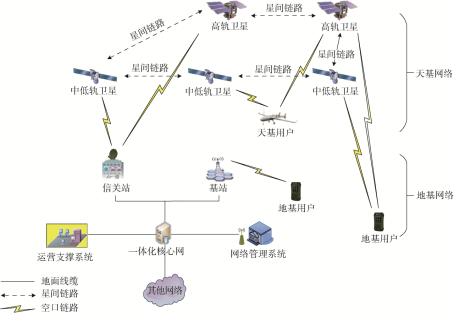
圖1 6G天地一體化網絡架構示意圖
本文詳細內容請下載:
http://www.jysgc.com/resource/share/2000006882
作者信息:
許強,王慧穎
(國家知識產權局專利局 專利審查協作天津中心,天津 300300)
此內容為AET網站原創,未經授權禁止轉載。